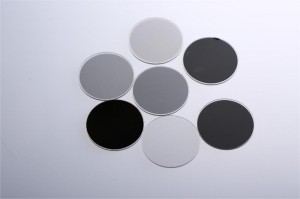
What neutral density filters do
Neutral density filters reduce the intensity of light across a wavelength range without strongly favouring one wavelength over another within that range. That even reduction is what makes them useful as attenuators: they let an instrument, a camera, or an optical system work with less light, while keeping the relative balance of the light largely unchanged. On this site, neutral density filters are one of only two lines with documented specification evidence, and the evidence below belongs to this product only. It is not a general specification for the catalogue, and it is not repeated on other filter pages.
Documented specification evidence
| Item | Documented value |
|---|---|
| Wavelength range | 200 to 1000 nm |
| ND value range | ND 0.1 to 4 |
| Size | Customized according to customer needs |
The wavelength range and ND value range above are the documented figures for this product. Size is not given as a fixed table, because sizes are customized according to customer needs. Buyers should therefore state the size they need in the inquiry, together with the ND value and the wavelength range their application covers. The neutral density filter selection guide explains how to choose within this documented range, and the ND filter manufacturer page covers the buying steps for procurement teams.
Documented application fields
The documented application fields for neutral density filters are ultraviolet measuring instruments, lasers, optical digital cameras, video cameras, security monitoring, optical instrument equipment, optical communication attenuation filters, optical imaging systems, smoke meters, optical measuring instruments, near-infrared spectrometers, and biochemical analysis. Those fields are application descriptions, not customer cases. No customer name, installation, or performance claim is attached to any field on this page. Each field uses attenuation for a different reason: a measuring instrument may need to bring a strong signal into its working range; a laser system may need controlled attenuation in a beam path; a camera or imaging system may need to reduce incoming light; a security monitoring system may need to manage bright scenes; and an optical communication path may need attenuation to balance signal levels. The filter choice in each case still comes back to the same three items: ND value, wavelength range, and size.
Choosing within the documented range
Start with the ND value your application needs. A higher ND value means stronger attenuation, and the documented range runs from ND 0.1 to 4. Next, check that your working wavelength range falls within 200 to 1000 nm, which is the documented range for this product. If your application works outside that range, state that range in your inquiry and ask for confirmation rather than assuming coverage. Then state the size you need, since sizes are customized according to customer needs. Finally, describe the system the filter will sit in, such as a measuring instrument, a laser path, a camera, a monitoring system, or an optical communication path, so that the requirement can be checked in context.
What this page does not claim
This page does not describe other attenuation forms, and it does not publish a fixed size table, a transmission curve, or a substrate list for neutral density filters, because those items are not documented for this product. Buyers who need a different attenuation form should describe that form in the inquiry and ask whether it is covered, rather than reading this page as covering it. This page also does not publish quantity or delivery figures. Please confirm the ND value, wavelength range, size, quantity basis, and delivery basis in your inquiry before ordering.
Related pages
For selection help, see the neutral density filter selection guide and the neutral density filter applications note. For the catalogue context, see interference filters and optical filter types. For buying, see the ND filter manufacturer page.