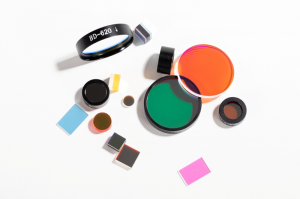
What fluorescence filters do
Fluorescence filters are interference filters used in fluorescence systems. On this site they are documented for two application families: biomedical fluorescence detection analysis systems, and real-time fluorescence quantitative PCR instruments. The PCR instrument application covers molecular biology, food safety testing, and public health epidemic monitoring. Those applications are stated with the documented source in mind: they are the applications listed for this product, and they are not extended into a claim that fluorescence filters serve every fluorescence application, or that they are dedicated to any single instrument brand or model. Buyers should describe their instrument and their dye or probe in the inquiry, so that the filter can be checked against the documented list rather than assumed to fit.
Coating and construction
The documented coating process for fluorescence filters is IAD hard coating. That statement belongs to this product only. It is not repeated on other filter pages as a general coating claim, because coating evidence for other lines is not documented at the same depth. The optical coatings guide explains coatings at category level and keeps the IAD hard coating statement attached to fluorescence filters. Multiple fluorescence filter pieces can be cemented together into a fluorescence filter set, which is useful when an application needs an excitation element, an emission element, and related elements working as one assembly. Buyers ordering a set should list each element they need and the dye or probe it serves, rather than ordering a set by name alone.
Documented specification evidence
The specification evidence documented for fluorescence filters is listed in the table below. Every figure in this table belongs to fluorescence filters only. It must not be read as a specification for narrow band pass filters, beam splitting filters, or any other line, and it must not be copied onto other pages as if it applied there.
| Item | Documented value |
|---|---|
| Coating | IAD hard coating |
| Excitation and emission examples | Ex 470-30 / Em 525-20; Ex 523-20 / Em 564-20; Ex 543-20 / Em 584-20; Ex 571-20 / Em 612-20; Ex 628-35 / Em 692-45; Cross greater than 6 |
| Blocking | OD greater than 6 at 200 to 900 nm, or at 200 to 1200 nm |
| Slope | 50 percent to OD5 less than 10 nm |
| Cross blocking | OD greater than 6 |
| Sizes | Diameter 4 mm, 12 mm, 12.7 mm, 25.4 mm, and others |
| Characteristics | Deep cut-off depth; low autofluorescence; multiple pieces can be cemented into a filter set |
The excitation and emission examples are examples from the documented list. They show the form in which excitation and emission values are given for this product, and they let a buyer compare a requirement against a documented example. They do not promise that every example fits every instrument, and they do not replace a specification confirmation in the inquiry. The blocking figures describe how strongly light outside the wanted band is blocked, and the slope figure describes how steeply transmission changes between the pass region and the blocked region. Buyers who need a blocking or slope figure for a different wavelength range should state that range in the inquiry and ask for confirmation.
Dye and probe names
The documented dye and probe names for fluorescence filters are FAM, SYBR Green, Green, HEX, TET, Cy3, JOE, ROX, Cy3.5, Texas Red, Cy5, LC Red640, and Cy5.5, with others in the same documented list. The fluorescence filter selection guide explains how to use this list when selecting a filter: start from the dye or probe your assay uses, then check the excitation and emission example that matches it, then confirm size and set composition. Names that are not in this documented list are not claimed for this product on this site. If your assay uses a dye or probe name outside this list, please state that name in your inquiry and ask whether it is covered, rather than assuming coverage from a similar name.
Applications in more detail
In biomedical fluorescence detection analysis systems, fluorescence filters separate the excitation light that stimulates a sample from the emission light that the sample gives back. That separation is the core optical job, and it is why blocking depth and slope matter: weak emission must be read against strong excitation, and stray excitation light must be kept out of the detector path. In real-time fluorescence quantitative PCR instruments, the same separation supports repeated fluorescence readings during amplification. The documented application fields for PCR instruments are molecular biology, food safety testing, and public health epidemic monitoring. Those three fields describe where the instrument application is documented, not a list of customers or a claim about installed instruments. No customer name, instrument brand, or installation case is published on this page.
What to confirm in your inquiry
Please confirm the following items in your inquiry before ordering: the dye or probe name from the documented list, or the dye or probe name you actually use if it is outside that list; the excitation and emission requirement for your instrument; the blocking range you need; the size you need from the documented sizes or the size you require; whether you need single pieces or a cemented filter set; and the quantity basis and delivery basis for your order. Please also confirm the specification, quantity basis, and delivery basis in your inquiry before ordering, because no quantity or delivery figures are published on this page. The PCR fluorescence guide covers the application side in more detail, and the dye selection note explains selection by dye and probe name.